
NDIS progress notes are concise, factual records that document the supports provided to a participant, the participant's response, and how those supports connect to their funded NDIS plan goals. Every registered provider in Australia must maintain accurate, contemporaneous records to meet their obligations under the NDIS Practice Standards and to remain audit-ready. These notes are not bureaucratic paperwork. They are the primary evidence that funded supports are being delivered as agreed, and they protect both participants and providers when questions arise. For guardians and families, they are the clearest window into what is actually happening during each support session.
What key information must an NDIS progress note include?
Compliant progress notes include six core elements: the date and time of the session, the specific supports and activities delivered, the participant's observable response, a clear link to their NDIS plan goals, any incidents or required follow-up actions, and a worker declaration confirming accuracy. Each element carries weight. Miss one and the note becomes harder to defend during an audit or plan review.
The six elements in practice look like this:
- Date and time: Record the exact start and finish time of the shift, not just the date.
- Supports delivered: Describe what actually happened. "Assisted with meal preparation and personal hygiene" is far more useful than "provided daily living support."
- Participant's response: Use observable facts. Write "participant completed three steps of the task independently" rather than "participant seemed motivated."
- Goal linkage: Name the specific NDIS goal the activity supports. Goal linkage is the most commonly missed element in progress notes, and its absence is a primary reason for audit non-compliance.
- Incidents or follow-up: Note any safety concerns, behavioural changes, or actions required. Reference any formal incident report separately.
- Worker declaration: The support worker signs or digitally confirms the note is accurate.
Routine notes typically range between 80 and 200 words, with longer entries reserved for incidents or significant milestones. That length is enough to cover all six elements without padding. Three to six clear sentences handle most routine shifts well.
Pro Tip: Write the goal linkage sentence first. It forces you to think about purpose before describing activity, which produces sharper, more useful notes every time.

When and how should you write your progress notes?
Timing is not optional. Notes should be completed within 24 hours of the shift, and ideally within 30 minutes of the session ending. Notes written days later are less reliable and are routinely questioned during audits. The closer to the shift, the more accurate and defensible the record.
Late or backdated notes create real risk. They suggest the support may not have occurred as claimed, which can trigger funding disputes or compliance investigations. Guardians relying on these records to track their family member's care are also left with gaps they cannot fill retrospectively.
Practical steps to write notes promptly:
- Take brief written or voice-memo notes during the shift to capture key observations in real time.
- Complete the full note immediately after the session before moving to the next participant.
- Use a structured template so you never have to think about format under time pressure.
- Store notes in a system that timestamps entries automatically, which removes any ambiguity about when the record was created.
NDIS registered providers must retain participant records for at least seven years, or until the participant turns 25 if services began during childhood. Records must be stored securely and in line with Australian Privacy Act requirements. Digital systems with encrypted storage and role-based access make this far easier to manage than paper-based filing.
Pro Tip: If your organisation uses a digital care platform, check whether it logs the timestamp of note creation automatically. That timestamp is your first line of defence in any audit.
Which formats and templates work best for NDIS progress notes?
Several structured formats exist for writing progress notes, and each suits different support types. Choosing the right format reduces the chance of missing key information and makes notes easier to read across a care team.
| Format | Structure | Best suited for |
|---|---|---|
| SOAP | Subjective, Objective, Assessment, Plan | Allied health and therapy sessions |
| DAP | Data, Assessment, Plan | Counselling and behavioural support |
| BIRP | Behaviour, Intervention, Response, Plan | Mental health and complex behaviour support |
| GIRP | Goal, Intervention, Response, Plan | Goal-focused community support |
| Narrative | Chronological prose description | Routine daily living and personal care shifts |
The narrative format suits most routine NDIS support shifts. It is simple, fast to write, and easy for any team member to read. SOAP and GIRP formats work well when a therapist or support coordinator needs to track progress against specific clinical or NDIS goals over time.
Copy-forwarded notes with minimal change are an audit red flag. Each note must be a unique, contemporaneous record of that specific shift. If a session closely resembles the previous one, use a phrase like "status consistent with prior session" and then describe what was actually different or observed that day. Copying full text from a previous note risks allegations of fraudulent billing, which is a serious compliance breach.
Pro Tip: Build a short checklist into your template: date and time, supports delivered, participant response, goal link, incidents, and worker signature. Run through it before submitting every note.
Common mistakes to avoid when writing progress notes
Documentation errors are far more common than most providers realise, and they compound over time. A single vague note is a minor issue. A pattern of vague notes across a participant's file is an audit problem.
The most frequent mistakes include:
- Subjective language: Words like "seemed," "appeared," or "was in a good mood" are not auditable. Objective language is non-negotiable for audit defence. Write what you observed or what the participant said directly.
- Missing goal linkage: Every activity must connect to a funded goal. "Assisted with cooking" is incomplete. "Assisted with cooking to build independent living skills, supporting Goal 3 of the participant's NDIS plan" is compliant.
- Copying previous notes: Copy-forwarding previous notes with minimal edits risks allegations of fraudulent billing. Each note must stand alone as a unique record.
- Late or incomplete entries: Notes written days after a shift are questioned during audits and undermine the credibility of the entire file.
- Confusing progress notes with incident reports: Incident reports are a separate mandatory document and must not be substituted by progress notes. Reference the incident report number within the progress note, but file them separately.
Pro Tip: Before submitting a note, ask yourself: "Could a support worker who has never met this participant understand exactly what happened today and why?" If the answer is no, the note needs more work.
How do well-written progress notes benefit participants and guardians?
Effective progress notes serve as communication tools that allow any support worker or clinician to understand a participant's current status without needing a verbal handover. That continuity directly improves the quality and safety of care, particularly when multiple workers support the same participant across a week.
For participants and their guardians, the benefits are concrete:
- Continuity of care: A new support worker can read the file and understand the participant's preferences, routines, and recent progress before the first session.
- Plan review evidence: Well-documented notes provide clear evidence of progress toward funded goals, which strengthens the case for continued or increased funding at plan review.
- Safety and incident management: Clear records of behavioural changes or health observations allow the care team to respond quickly and appropriately.
- Guardian transparency: Families and guardians can see exactly what supports were delivered, when, and how the participant responded. That visibility builds trust and reduces anxiety.
- Provider compliance: Documentation is not just for audits. Writing notes that reflect actual daily work improves service quality and protects the participant's safety over time.
The participant sits at the centre of every note. When documentation reflects their real experience and progress, the entire care system works better for everyone involved.
Key takeaways
Compliant NDIS progress notes require six core elements, objective language, goal linkage, and timely completion to protect participants, support plan reviews, and satisfy audit requirements.
| Point | Details |
|---|---|
| Six core elements | Every note must include date, supports, participant response, goal link, incidents, and worker declaration. |
| Write notes promptly | Complete notes within 24 hours of the shift, ideally within 30 minutes, to maintain accuracy and audit defensibility. |
| Use objective language | Replace subjective terms with observable facts or direct participant quotes to meet compliance standards. |
| Link every activity to a goal | Name the specific NDIS plan goal each support activity addresses; missing this is the most common audit failure. |
| Never copy-forward notes | Each note must be a unique record of that shift; copied notes risk fraud allegations and audit non-compliance. |
Why I think most providers are writing notes for the wrong reason
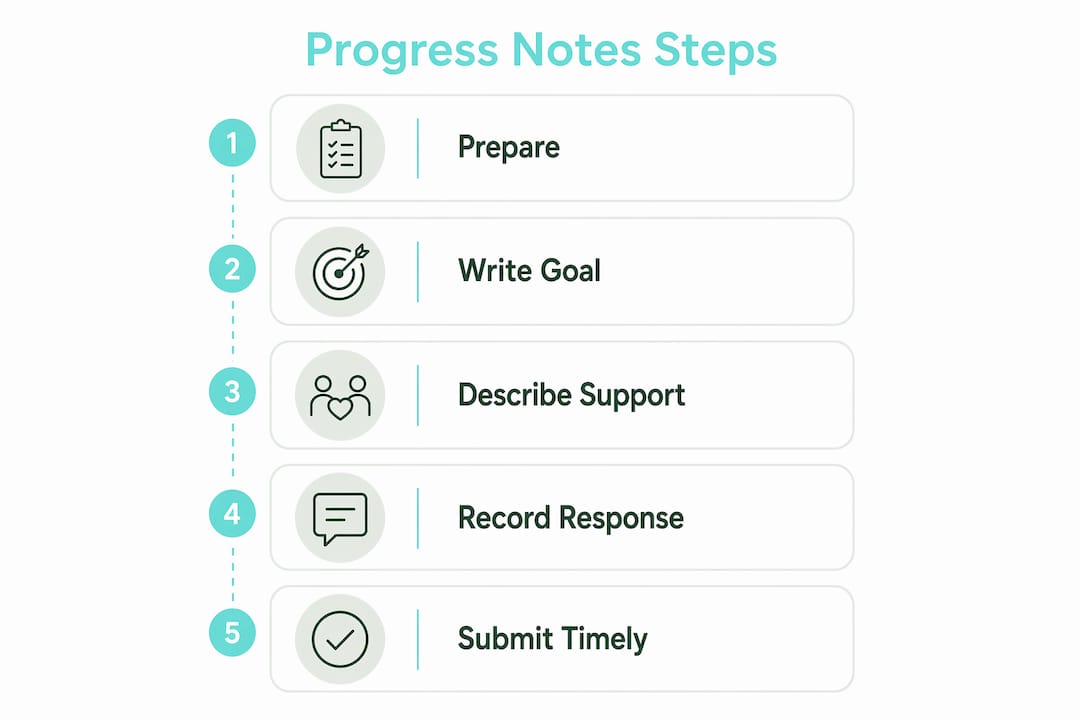
Most support workers write progress notes because they have to. The audit looms, the supervisor checks, the template gets filled. That mindset produces exactly the kind of documentation that fails when it matters most: vague, copied, goal-free, and written two days after the shift.
The notes that actually hold up, and more importantly, the notes that actually help participants, are written by workers who understand they are creating a live record of someone's care. When I look at files that have sailed through audits and supported strong plan reviews, they share one quality: the worker wrote as if the next person reading the note would need to care for that participant tomorrow without any other information. That is the standard worth aiming for.
Goal linkage is where most notes fall apart. Workers describe what they did but not why it matters to the participant's funded outcomes. Fixing that one habit changes the entire quality of a file. Write the goal first, then describe the activity that served it.
The other thing I have seen repeatedly is the false belief that longer notes are safer notes. More detail does not equal better compliance. A long, rambling note mixing opinions and observations harms audit outcomes more than a brief, well-structured one. Clarity and relevance matter far more than word count.
— bulent
Ciaralink and connected NDIS documentation
Good documentation does not happen in isolation. When notes, schedules, and participant records live in disconnected places, things get missed.
Ciaralink is built specifically for Australian NDIS providers and connects progress notes, care plans, and participant records in one place. Role-based access means support workers, coordinators, and guardians each see exactly what they need. Automated record-keeping and encrypted storage keep your documentation audit-ready without extra admin. Participants and families get real visibility over the supports being delivered. Ciaralink operates on a flat subscription model, so providers keep 100% of their funding. If your team is managing NDIS documentation across disconnected systems, explore Ciaralink's platform and see how connected care changes the picture.
FAQ
What are NDIS progress notes?
NDIS progress notes are factual, contemporaneous records that document the supports delivered to a participant, the participant's response, and how those supports link to their NDIS plan goals. They are a mandatory part of registered provider obligations under the NDIS Practice Standards.
How long should an NDIS progress note be?
Routine progress notes typically range between 80 and 200 words. Three to six clear sentences cover most standard shifts, with longer entries required for incidents or significant milestones.
How soon after a shift should progress notes be written?
Notes should be completed within 24 hours of the shift, and ideally within 30 minutes. Notes written days later are less reliable and are routinely questioned during NDIS audits.
How long must NDIS providers keep progress notes?
Registered providers must retain participant records, including progress notes, for at least seven years. If services began during a participant's childhood, records must be kept until the participant turns 25.
What is the most common mistake in NDIS progress notes?
Missing goal linkage is the most common compliance failure. Every support activity must clearly name the NDIS plan goal it addresses, not just describe what the worker did during the shift.