
NDIS audit preparation is the process of organising your policies, evidence, staff, and operations to demonstrate full compliance with the NDIS Practice Standards during certification or verification audits conducted by Approved Quality Auditors on behalf of the NDIS Quality and Safeguards Commission. Getting this right protects your registration, your participants, and your team. Providers who treat preparation as an ongoing practice rather than a last-minute scramble consistently achieve better audit outcomes. This guide walks you through every stage of the process, from understanding which audit type applies to you, through to building an evidence map, preparing your staff, and avoiding the most common non-conformances.
What are the NDIS audit types and how do they affect preparation?
The audit pathway your organisation follows depends on the registration groups you hold and the risk level of the supports you deliver. Understanding your pathway early shapes every preparation decision you make.
Verification audits apply to lower-risk registration groups. They are conducted as a desktop review, meaning auditors assess your documents without visiting your site. Preparation focuses on submitting complete, current policies, procedures, and evidence of practice.

Certification audits apply to higher-risk registration groups, including those delivering specialist supports. Certification audits run in two stages: an off-site document review of governance records, policies, training records, and participant files, followed by an on-site assessment that includes staff interviews and direct observation of practice. This two-stage structure means your preparation must cover both your paperwork and your people.
Mid-term audits occur roughly halfway through a registration period. They focus on governance, continuous improvement, and whether you have addressed any non-conformances from your previous audit. Providers often underestimate mid-term requirements and treat them as a lighter version of certification. They are not.
Provisional and re-registration audits follow the same general framework as initial certification but require you to demonstrate growth and sustained compliance over time.
Key preparation differences by audit type:
- Verification: Prioritise document currency, version control, and completeness of evidence bundles.
- Certification Stage 1: Organise governance documents, risk registers, training logs, and participant files for off-site review.
- Certification Stage 2: Prepare staff for interviews, arrange site access, and confirm practice aligns with documented policies.
- Mid-term: Demonstrate active continuous improvement and resolution of prior non-conformances.
Which NDIS Practice Standards do auditors assess?
The NDIS Practice Standards are the benchmark against which every audit is measured. They are structured into a Core Module, which applies to all registered providers, and Supplementary Modules that apply based on your registration groups. Supplementary Modules cover areas such as specialist support coordination, behaviour support, and high-intensity daily activities.
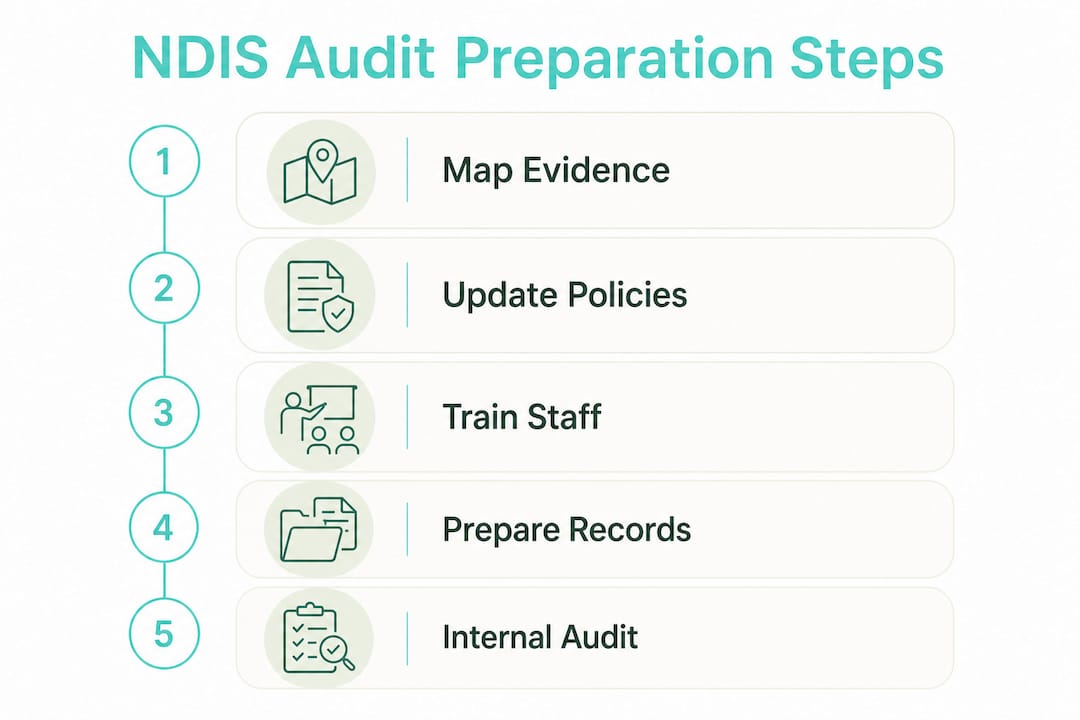
Each standard contains Quality Indicators. These are the specific criteria auditors use to determine whether your organisation meets the standard. Mapping your evidence directly to each Quality Indicator is the single most effective way to reduce auditor scrutiny and demonstrate compliance with confidence.
An evidence map is a document or spreadsheet that lists each Quality Indicator in one column and links the corresponding policy, procedure, record, or file in the next. It gives auditors a clear path through your evidence and shows you have thought carefully about each requirement.
The types of documents that typically serve as evidence include:
- Governance and risk management policies
- Incident management and complaints procedures
- Participant support plans, service agreements, and consent forms
- Worker screening registers and training records
- Meeting minutes and continuous improvement logs
Pro Tip: Build your evidence map as a living document. Update it whenever you review a policy or add a new record. By audit time, it becomes your single source of truth rather than a frantic last-minute assembly.
How to prepare your policies, records, staff, and participant files
Thorough preparation across four areas gives you the best chance of a clean audit result. Work through each area methodically, ideally starting at least three months before your audit date.
Policies and procedures
- Review every policy for currency. Policies must be reviewed within the last 12 months with evidence of staff acknowledgement, version control, and sign-off by an authorised person. Auditors check review dates and signatures.
- Confirm policies cover all required areas: governance, risk management, incident management, complaints, privacy, and worker safety.
- Store policies in a location all staff can access. A shared digital folder or care management platform works far better than a filing cabinet in the manager's office.
Worker screening and training records
Expired or missing NDIS Worker Screening Checks are among the most common audit non-conformances. The first wave of five-year screening checks began expiring in February 2026, which means many providers now face a wave of renewals. Maintain a live register that shows each worker's check status, expiry date, and renewal date. Set calendar alerts at least 60 days before expiry.
Training records must show completion dates, topics covered, and evidence of competency. Mandatory training areas typically include NDIS Code of Conduct, incident reporting, and safeguarding.
Incident and complaints logs
Incident records must be completed in real time and meet NDIS notification timeframes, including 24-hour reporting for serious incidents. Auditors look beyond the log entry itself. They want to see investigation outcomes, actions taken, and evidence that the incident informed a change in practice or policy.
Your complaints register must show each complaint received, the response provided, and the resolution. A register with no complaints recorded is a red flag, not a sign of excellence.
Participant files and staff preparation
- Confirm each participant file contains a current support plan, signed service agreement, and up-to-date consent forms.
- Check that goals are documented and that progress notes link back to those goals.
- Conduct at least two staff briefing sessions before the audit. Cover what auditors will ask, how to describe daily practice, and where to find key documents.
- Run mock interviews with frontline workers. Well-prepared staff can clearly explain policies, reporting obligations, and how they support participants, which significantly improves audit outcomes.
Pro Tip: Ask a staff member who was not involved in writing your policies to read them and explain them back to you. If they struggle, your policies need clearer language before the audit.
Common audit pitfalls and how to avoid them
Most audit non-conformances are preventable. They fall into a small number of recurring categories that providers can address well before an auditor arrives.
- Outdated policies: A policy dated more than 12 months ago without a review record fails the currency test immediately. Schedule annual policy reviews in your quality calendar.
- Expired worker screening: Build renewal alerts into your rostering or HR system. Do not rely on workers to self-report expiry dates.
- Incomplete incident logs: A log that records the incident but shows no follow-up investigation or outcome is treated as non-compliant. Close every incident record with documented actions.
- Stagnant risk registers: A living risk register must show ongoing review, current risks, mitigation plans, and monitoring evidence. A register that has not been updated in six months signals that risk management is not active.
- Unprepared staff: Workers who cannot explain how they report an incident or where to find the complaints procedure create doubt about whether policies are embedded in practice.
- No internal audit process: Providers who conduct regular internal audits catch these issues before an Approved Quality Auditor does.
"Auditors are not trying to catch providers out. Their role is to assess whether your organisation genuinely meets the NDIS Practice Standards. A clear evidence map and well-prepared team make that assessment straightforward for everyone involved." — Audit experts consistently emphasise this collaborative intent.
The most effective safeguard against non-conformances is a scheduled internal audit every six months. Treat it as a dress rehearsal. Walk through your evidence map, check every register, and interview two or three staff members using the same questions an auditor would ask.
How does technology support NDIS audit readiness?
Digital platforms that integrate record-keeping for progress notes, rostering, incident logs, and training records significantly reduce manual errors and support version control across all compliance documents. The practical effect is that your evidence is always current, always accessible, and always linked to the right participant or worker record.
| Compliance area | Manual approach | Digital platform approach |
|---|---|---|
| Policy version control | Paper folders, manual date tracking | Automatic versioning with review alerts |
| Worker screening register | Spreadsheet updated manually | Live register with expiry notifications |
| Incident management | Paper forms filed separately | Real-time logging with outcome tracking |
| Progress notes | Handwritten or disconnected apps | Linked to participant goals and shift records |
| Training records | Certificates stored in folders | Centralised log with completion dates |
CiaraLink brings all of these functions into one connected system built specifically for Australian NDIS providers. Progress notes, shift records, incident reports, rostering, and service agreements all live in the same place. That means when an auditor asks for evidence, you are not searching across five different folders or apps. You pull it from one place.
Pro Tip: Set a recurring monthly task in your care management platform to check policy review dates, screening expiry dates, and open incident records. Fifteen minutes a month prevents hours of panic before an audit.
Key takeaways
Effective NDIS audit preparation requires mapping evidence to the NDIS Practice Standards, maintaining current policies and worker screening records, and preparing staff to speak confidently about their practice.
| Point | Details |
|---|---|
| Know your audit type | Verification, certification, and mid-term audits each require different levels of evidence and preparation. |
| Build an evidence map | Link every Quality Indicator to a specific document or record before the audit date. |
| Keep policies current | Policies must be reviewed within the last 12 months with version control and staff sign-off. |
| Maintain live registers | Worker screening and risk registers must show active monitoring, not just a snapshot in time. |
| Prepare your staff | Mock interviews and briefing sessions give workers the confidence to explain their practice clearly. |
What I have learned about NDIS audits after years in the sector
The most persistent misconception I encounter is that audits are adversarial. Providers brace for an interrogation. They hide gaps rather than address them. That mindset makes audits harder than they need to be.
Auditors are compliance professionals assessing whether your organisation genuinely supports participants safely and well. When your evidence is organised and your staff can speak to their practice, the audit becomes a conversation rather than a confrontation. I have seen small providers with modest resources sail through certification because their documentation was honest, current, and clearly mapped to the standards. I have also seen larger organisations stumble because their policies were polished but their staff had never read them.
The providers who do best treat audit preparation as a year-round habit, not a six-week sprint. They review policies on a rolling schedule. They run internal audits twice a year. They brief staff regularly, not just in the week before an auditor arrives. That consistency shows up in the evidence, and auditors notice it immediately.
If I had one piece of advice for any provider heading into a certification audit, it would be this: build your evidence map first. Everything else flows from knowing exactly what you need to demonstrate and where your proof sits.
— Bulent Karamanoglu
CiaraLink and your NDIS compliance
Keeping audit-ready documentation across progress notes, incident logs, worker screening, and policies is a full-time job when your records live in disconnected places.

CiaraLink is built for Australian NDIS providers who want their compliance records in one connected system. Progress notes link to participant goals. Incident reports feed directly into your compliance log. Worker screening expiry dates sit alongside your rostering. Policies are accessible to every staff member from any device. The result is less time searching for evidence and more time delivering care. Visit CiaraLink to start a free trial and see how it supports your audit readiness from day one.
FAQ
What is NDIS audit preparation?
NDIS audit preparation is the process of organising policies, evidence, staff training, and participant records to demonstrate compliance with the NDIS Practice Standards during an audit by an Approved Quality Auditor.
How long before an audit should providers start preparing?
Starting at least three months before your audit date gives you time to review policies, update registers, address gaps, and conduct staff briefing sessions without rushing.
What documents do auditors commonly request?
Auditors typically request governance policies, risk registers, incident and complaints logs, worker screening registers, training records, and participant files including support plans and consent forms.
What happens if a provider fails an NDIS audit?
A failed audit results in non-conformances that must be addressed within a set timeframe. Serious or repeated non-conformances can lead to conditions on registration or, in extreme cases, suspension of registration by the NDIS Quality and Safeguards Commission.
How do you fix gaps found during audit preparation?
Address each gap by updating the relevant policy or record, documenting the change, and noting it in your continuous improvement log. Auditors view documented self-correction positively as evidence of an active quality system.