Finding NDIS provider management software that matches Australian compliance, pricing transparency, and integration needs is harder than it should be. Commission-based platforms, limited public pricing, or steep minimum user counts raise costs and lock out smaller providers. This comparison covers transparent pricing, accounting integrations, and workflow coverage so community care teams can pick a platform that fits their participant volume and budget.
Table of Contents
- CiaraLinkCARE OS
- Astalty
- SupportAbility
- CareMaster
- Brevity Care Software
- Careview
- Comparison of alternatives
CiaraLinkCARE OS
At a Glance
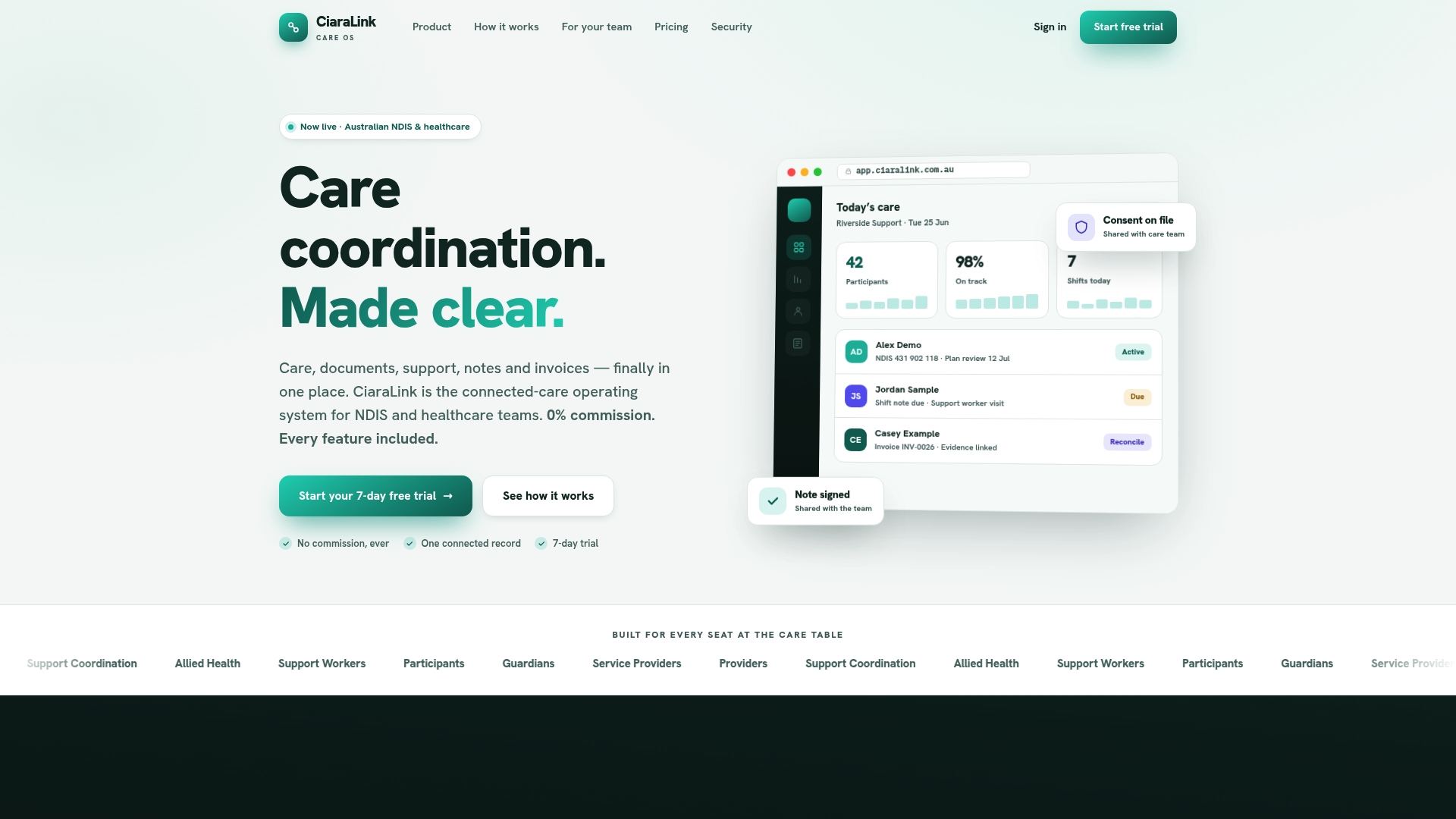
0% commission on care services preserves all funding for providers. The platform uses a flat subscription pricing model, so providers keep full revenue from shifts. CiaraLinkCARE OS is in launch preview and focuses on Australian NDIS workflows and data residency.
Core Features
CiaraLinkCARE OS stores a single connected record for participants, teams, notes, documents, and invoices so care details are held in one place. The system automates notes, documents, invoice generation, and evidence reconciliation while offering role based access, consent controls, shift scheduling, and visit verification tools. Encrypted data storage and transport support Australian privacy expectations and onshore residency.
Key Differentiator
The platform’s defining feature is a flat subscription with every feature included and no commissions on care services, which preserves funding for providers and families. That pricing model changes the economics of rostering and billing for NDIS providers compared with commission marketplaces. The product is purpose built for Australian NDIS and healthcare workflows.
Pros
Keeping 100% of care funding reduces revenue leakage and lets smaller providers plan budgets with predictable costs. Role specific views and one connected record cut time spent chasing emails and paper files, and automated reconciliation of invoices with shift evidence reduces manual checking. Built with local privacy and residency in mind, the platform centralises participant consent and team collaboration while handling scheduling, visit verification, and secure storage.
Cons
- Early stage platform currently in launch preview, so some features may still be under development.
Who It's For
Australian NDIS providers, support coordinators, allied health professionals, and support workers who need a single place to manage participants, evidence, rostering, and billing. It suits organisations that want to avoid commission marketplaces and prefer predictable subscription costs. It is not suited to teams operating outside the Australian NDIS context.
Unique Value Proposition
Built in Australia with role based access, consent management, and onshore data residency, CiaraLinkCARE OS ties clinical notes to invoices and shift evidence in a live participant record. That setup reduces duplication and makes audits and guardian reviews simpler. For providers worried about privacy and funding flow, the model preserves revenue and keeps documentation visible to authorised people.
Real World Use Case
An NDIS provider moves participant files, roster details, and invoices into CiaraLinkCARE OS. Staff stop searching email chains and paper notes, so travel claims and visit evidence attach directly to invoices. Guardians gain clearer access to consent records and team communication.
Pricing
Monthly plans start at AUD 199 for up to five clients, with tiered plans for larger organisations and savings for annual billing. Custom enterprise options are available for bigger providers.
Website: https://ciaralink.com.au
Astalty
At a Glance
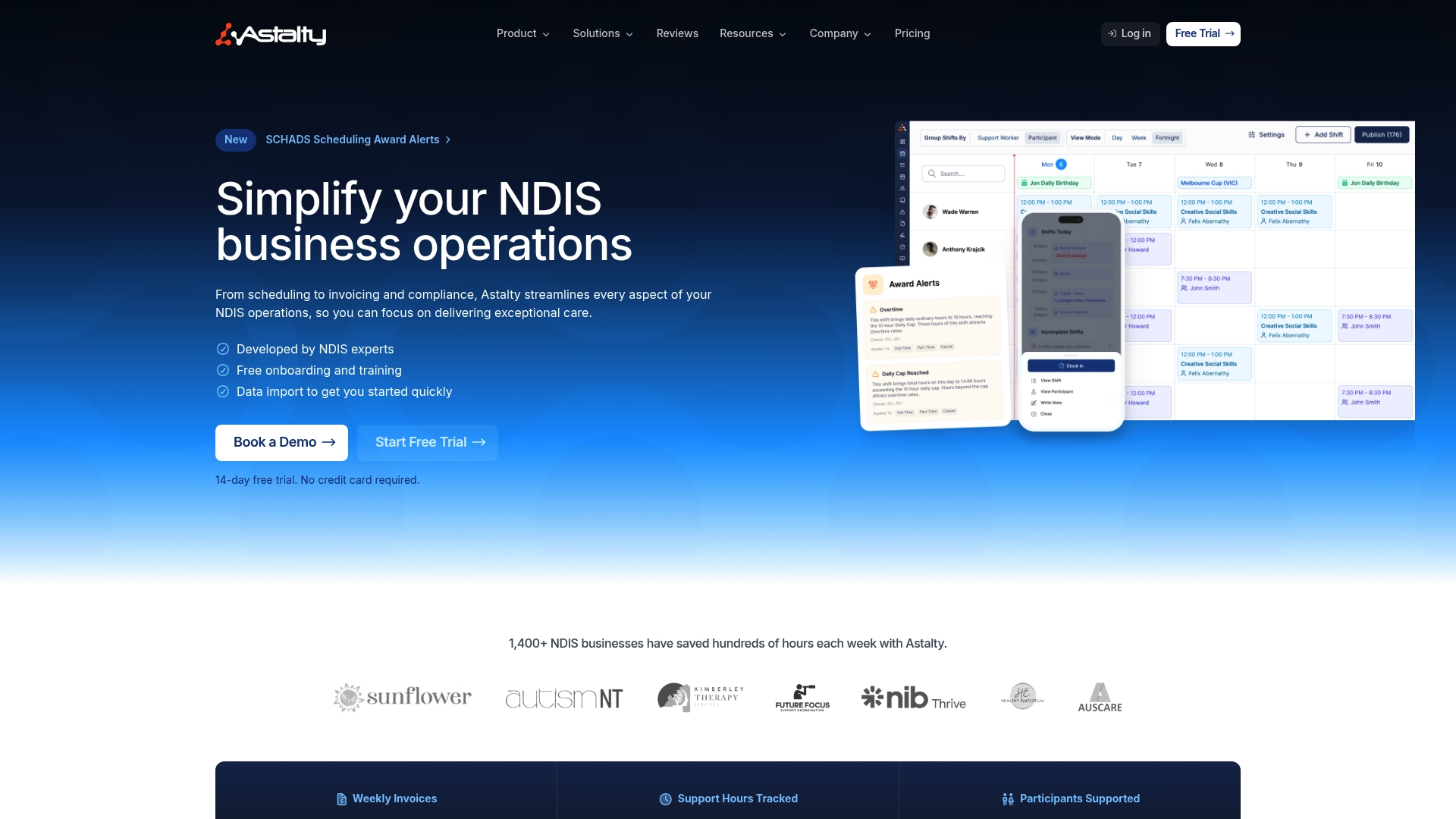
Astalty reports it is trusted by over 1,400 organisations. The platform focuses on the practical workflows of Australian NDIS providers and ties scheduling, invoicing, and compliance together. That focus aims to cut administration time for support coordinators and office staff.
Core Features
Astalty groups participant records, funding trackers, service agreements, and referral notes in one place, so files do not sit in multiple systems. Scheduling and rostering include conflict alerts, a support worker mobile app, and tools for managing group activities. Business operations cover automated NDIA claims, e-signatures, reporting, and integration with payroll and accounting.
Key Differentiator
Astalty centres its product on the Australian NDIS sector and maps common NDIS tasks into prebuilt workflows. That positioning reduces the need to adapt a generic practice management tool for NDIS rules. The product links planning, billing, compliance, and participant management inside a single environment.
Pros
Astalty is aimed squarely at NDIS providers, so common tasks for support coordinators are already modelled. The onboarding and training offering helps teams get started faster and lowers early friction. Integration with accounting and payroll systems reduces manual reconciliation between claims and ledgers. Flexible pricing and no minimum user rules make it viable for small providers as well as larger agencies.
Cons
-
The platform has a noticeable learning curve for teams new to full-suite care software.
-
Some buyers ask for deeper customisation of forms and workflows.
-
The product applies only within the Australian NDIS sector, so it is not suitable for international operations.
-
Initial billing and integration setup can need technical support during implementation.
When It May Not Fit
If your organisation operates outside Australia, Astalty will not match local funding or reporting rules. Large organisations with complex legacy systems may need vendor support for data migration. If you require heavy bespoke workflow customisation, other platforms may offer more developer-level options.
Notable Integrations
Astalty connects with Xero accounting for financial reconciliation and payment records. It also links to workflow automation tools to push triggers between systems. Payroll platforms listed include PayCat and Employment Hero for staff payments and entitlements.
Who It's For
This product fits NDIS support providers, support coordinators, and disability service agencies that need a single system for participant records and claiming. It suits teams that want built-in NDIS workflows rather than heavy customisation. Smaller providers benefit from the no-minimum-user pricing model.
Real World Use Case
A multi-site disability service provider runs scheduling and group activities across three locations. Staff use the mobile app for shift confirmations and incident reporting. Office admins submit bulk NDIA claims and match them to Xero without manual journal entries.
Pricing
Pricing starts at $64 per standard user per month and $30 per support worker per month. Astalty offers a 14-day free trial with no credit card required.
Website: https://astalty.com.au
SupportAbility
At a Glance
SupportAbility reports more than 8,000 users across over 100 organisations, and the vendor advertises billions in NDIS supports delivered plus tens of thousands of participants supported. The platform targets NDIS registered providers and emphasises compliance, billing, and field mobility. That scale claim helps explain its feature depth and sector focus.
Core Features
SupportAbility combines client records, goal tracking, and evidence collection with NDIS invoicing and claim management. It includes reporting and compliance tools that link to finance and payroll systems, plus a mobile app with offline capability and bulk payment requests. Privacy controls and audit ready evidence collection sit alongside fund and budget management.
Key Differentiator
SupportAbility was built specifically for NDIS providers and prioritises compliance and regular releases to reflect scheme changes. It also focuses on deep connections to financial systems and to the MyPlace portal so billing and reporting stay aligned with NDIS workflows.
Pros
Strong compliance tools are a clear strength, with regular feature updates and reporting designed for audit traces. The vendor states it has evolved over 20 years, which shows up in templates and sector specific workflows. The mobile app supports staff in the field with offline recording and evidence capture, and multiple organisation management gives real time access across teams.
Cons
- Does not support the Remote and Very Remote NDIS Price Guides, which limits use for remote providers. This omission affects billing for those regions.
- The smallest subscription covers 30 staff, which raises the entry cost for sole practitioners and very small organisations. Smaller teams will find this prohibitive.
- Custom integrations beyond finance and payroll may require extra cost and development time. Expect longer lead times for niche systems.
When It May Not Fit
If your services rely on the Remote or Very Remote price guides, SupportAbility will not meet billing needs. Solo practitioners and micro providers will find the minimum seat requirement too large. Organisations needing a bespoke ecosystem with many non finance integrations should budget for extra work.
Notable Integrations
SupportAbility connects with common Australian finance tools. Notable integrations include Xero, MYOB, QuickBooks Desktop via Zed Axis, Reckon, Sage Evolution, and Tencia. These links cover payroll and accounting workflows used by many disability providers.
Who It's For
This product suits NDIS registered service providers and disability organisations that manage many participants and staff. It fits teams that must produce audit ready evidence, handle NDIS invoicing, and coordinate field workers. Small solo providers are not the intended audience.
Real World Use Case
Leisure Networks uses SupportAbility to consolidate client care, automate billing, and keep compliance records tidy. They capture evidence in the field with the mobile app, match records to plans, and push invoices through linked finance systems. That workflow reduced manual reconciliation for their admin team.
Pricing
Pricing detail is not published here. The vendor states the smallest subscription is for 30 staff, so budget accordingly for the minimum seat requirement and potential custom integration costs.
Website: https://supportability.com.au
CareMaster
At a Glance
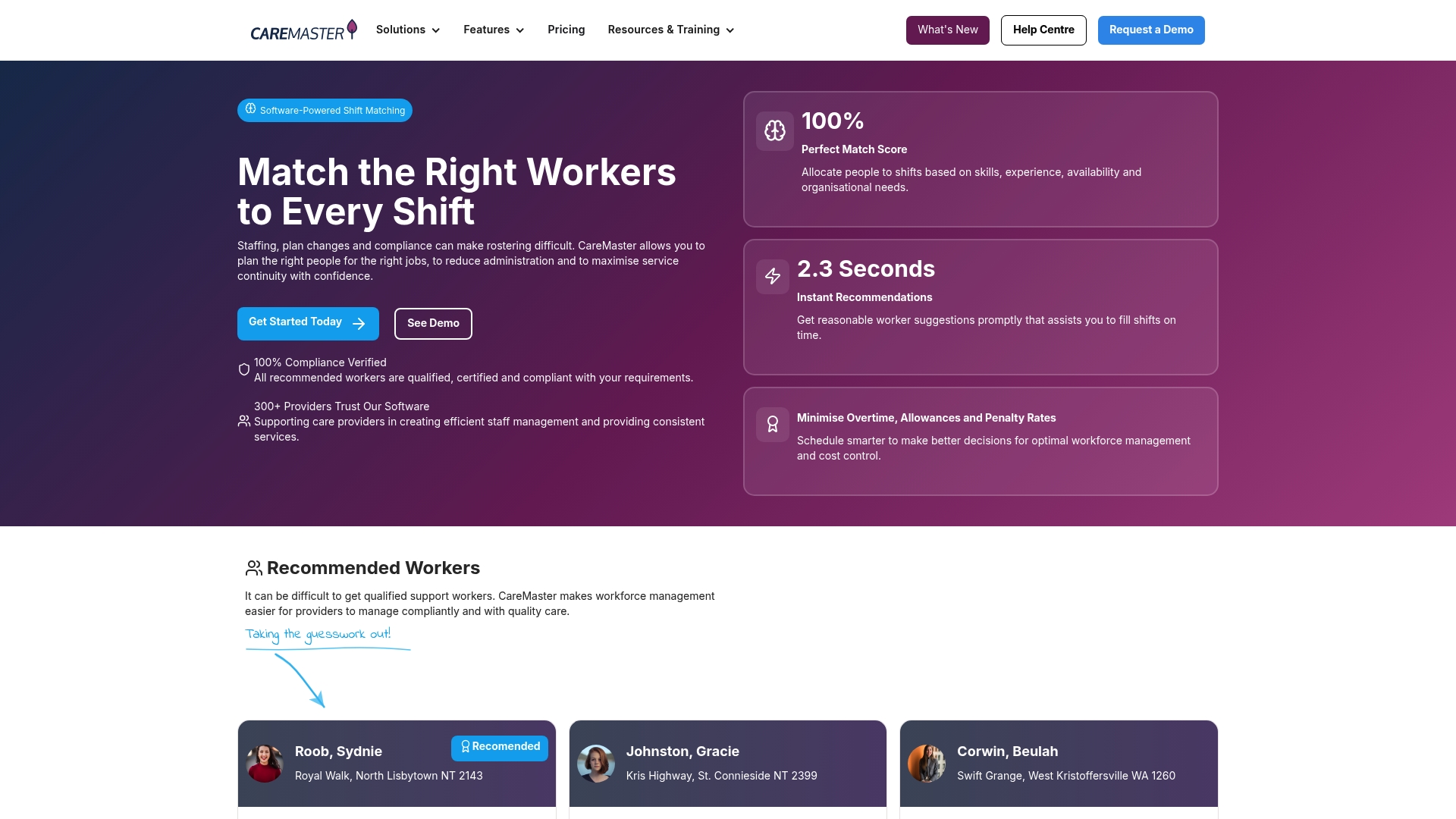
CareMaster's marketing materials state ISO 27001 accreditation. That security claim stands out for a provider-facing care platform. The vendor also lists a starting price of $16 per user per month for the Essential package.
Core Features
CareMaster bundles case notes, incident records, and service agreement templates into a single cloud platform that links participant records to rostering and compliance checks. The rostering tools include smart filters and AI-enhanced shift matching while dedicated apps give support workers and participants live access to schedules and records. Financial features cover invoicing, payroll, expense tracking, and reporting with APIs to connect to accounting systems.
Key Differentiator
CareMaster targets Australian NDIS and aged care providers with features built around local funding and compliance rules. The platform combines AI-enhanced rostering with direct links to common accounting systems and government workflows. That industry focus makes it more tailored to Australian providers than general practice management tools.
Pros
The product offers a broad set of care workflows in one cloud platform, reducing the need to switch between separate tools. The vendor advertises ISO 27001 accreditation and that accreditation supports a higher security posture for client data. Apps for support workers and participants make day to day communication and real time updates practical, and integrations with accounting software reduce manual reconciliation work.
Cons
- Pricing may be on the higher side for very small providers depending on scale.
- Feature complexity can require dedicated training before staff use all functions effectively.
- Extensive customization options may feel overwhelming during early setup.
When It May Not Fit
Providers with very tight budgets who need a minimal feature set may find the entry costs hard to justify. Organisations that require strong offline capabilities will notice limited functionality when internet access is unreliable. Small teams without capacity for formal training may prefer a simpler rostering tool.
Notable Integrations
CareMaster connects to accounting and payroll platforms such as Xero, MYOB, and KeyPay. The vendor also supports integrations to external accountants and other financial software via APIs. These connections speed financial reconciliation and payroll processing when they are configured.
Who It's For
Australian disability and aged care service providers that need an integrated platform for care records, rostering, and billing will suit CareMaster. It fits providers that must meet regulatory requirements and want participant access via mobile apps. Larger organisations or those planning growth will benefit most from the scalability and integration options.
Real World Use Case
A regional NDIS provider uses CareMaster to automate rostering, match staff by compliance needs, and publish schedules to worker apps. The same provider links participant budgets and invoicing to payroll, which cuts time spent on reconciliation. That workflow frees coordinators to focus on care planning rather than admin tasks.
Pricing
Pricing tiers start at $16 per user per month for the Essential package and scale to enterprise options. All plans include the support worker and participant apps. Exact costs depend on provider size and selected feature modules.
Website: https://caremaster.com.au
Brevity Care Software
At a Glance
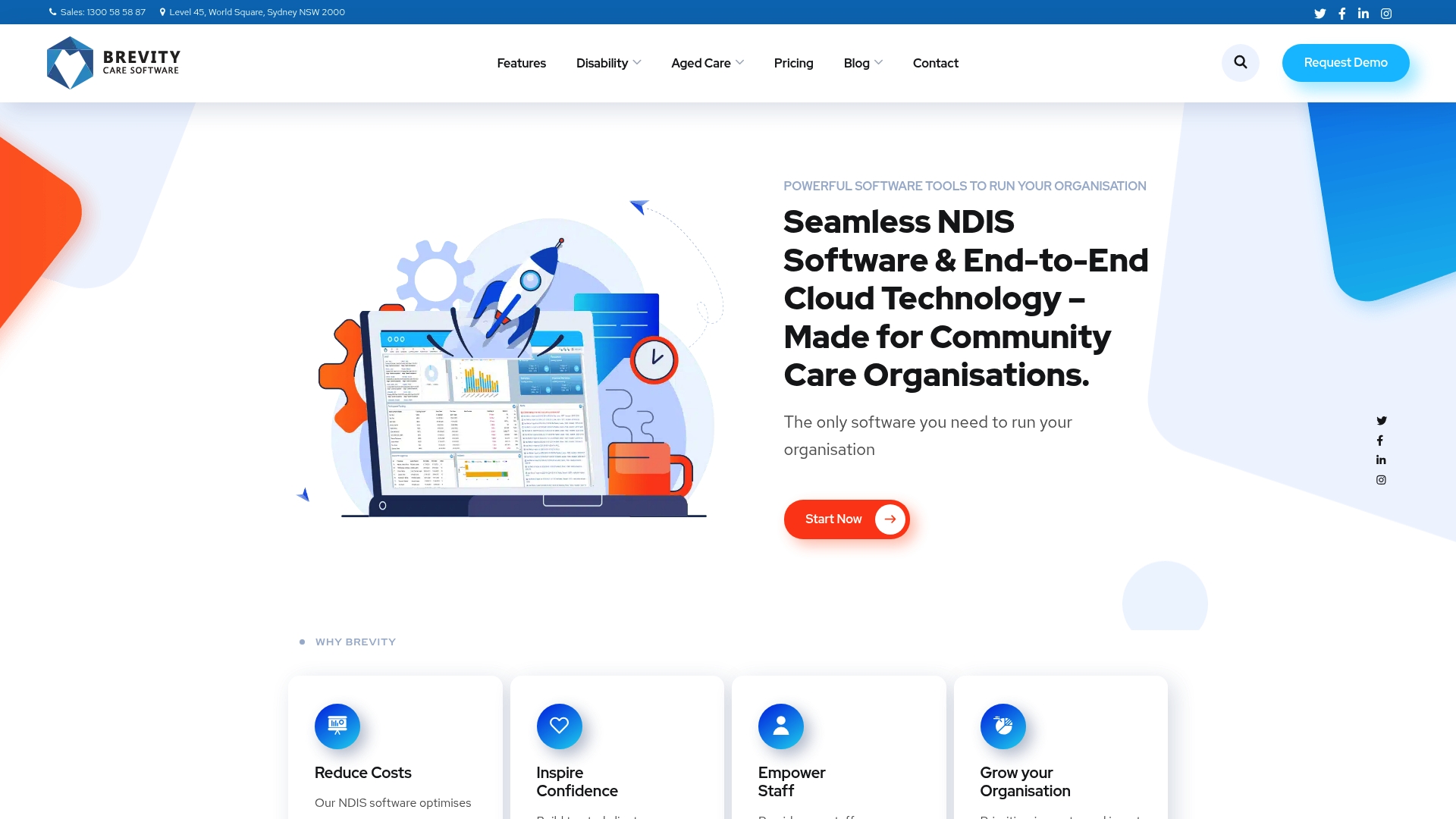
Starting from $44.90/month for the Lite plan, Brevity targets community care teams with packaged pricing and higher tiers for enterprise needs. The pricing model makes it clear where small teams end and larger implementations begin. The platform focuses on NDIS, aged care, plan management, support coordination, allied health, and supported independent living.
Core Features
Brevity combines client and support management, automated billing and claims processing, and real time funding and budget tracking into a single cloud system. Customisable care planning and rostering sit alongside secure document management and in app communication tools so administrators and support staff can coordinate care and paperwork from one live record. The platform also integrates with accounting and other systems to reduce duplicate data entry.
Key Differentiator
Brevity is built specifically for Australian disability and aged care providers with workflows and compliance features tailored to local rules and funding models. That industry focus shows up in plan level funding views and rostering rules that match common NDIS practice. This makes it narrower in scope than general practice software but much more aligned to community care teams.
Pros
The product offers an end to end cloud workflow that covers client onboarding, rostering, claims, and reporting in the same system which reduces switching between tools. The vendor advertises certification to international standards for data security and privacy, which may suit providers with strict compliance needs. Customisation and integration options let larger organisations map Brevity to existing accounting or reporting systems while mobile apps support staff working in the field.
Cons
- Implementation can be complex and often needs dedicated onboarding support. This adds time and cost before teams become productive.
- The breadth of features creates a learning curve for staff who only need a few modules. Training investment can be significant.
- Cost may be prohibitive for very small organisations or solo practitioners when enterprise features are required.
When It May Not Fit
If your organisation needs only basic client records and simple invoicing, Brevity may be more than required. Very small teams may find setup and ongoing licensing costs higher than lightweight alternatives. Organisations seeking a generic practice management tool rather than a community care specialist should look elsewhere.
Who It's For
Community care organisations, disability providers, aged care services, and support coordinators that need an integrated system for client records, claims, rostering, and compliance will get the most value. Larger teams that plan to integrate with accounting systems and that can commit to structured onboarding will benefit most. Small solo practitioners may find the platform heavier than necessary.
Real World Use Case
An NDIS provider uses Brevity to manage client onboarding and support planning, then rostering and claims submission through the same workflow. Staff access client budgets and service records from mobile devices during home visits. That consolidated record reduces time spent reconciling funding and raises visible audit trails for auditors and families.
Pricing
Pricing starts at $44.90/month for the Lite plan with higher tiers offering additional features and scale. Custom enterprise pricing is available on application for larger organisations and integrations.
Website: https://brevity.com.au
Careview
At a Glance
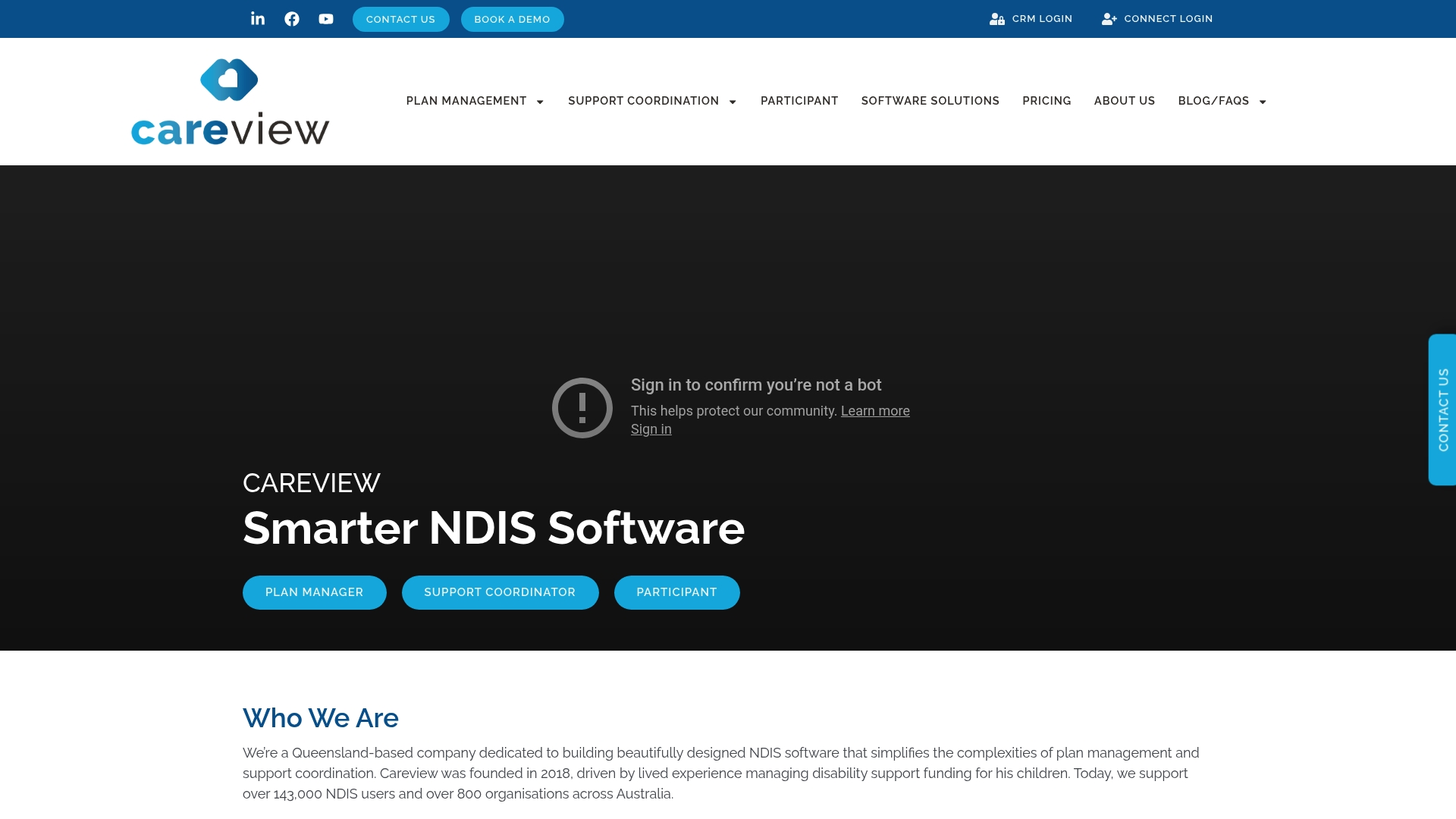
Careview reports supporting over 143,000 users across Australia. It is a cloud-based tool aimed at plan managers and support coordinators, with features for invoicing and compliance. The company is based in Queensland and offers flexible pricing with no fixed contracts.
Core Features
Careview provides cloud-based plan management with tools for creating category budgets and tracking participant funding, and it handles automated invoicing and compliance tracking. The platform supports bulk NDIS claiming and links to accounting and government systems, using connectors such as SyncPro to reduce duplicate data entry. Careview also allows remote access from web and mobile devices.
Key Differentiator
Careview focuses on Australian support providers and plan managers with workflows tuned to NDIS billing and compliance. Its strength is the built-in connectors to accounting software and government services that cut manual reconciliation. That focus makes it practical for teams that need to finance reconciliation alongside PRODA access.
Pros
Careview's marketing materials state it reduces administrative time by approximately 50%. That claim, if realised, frees coordinators to spend more time on participant engagement rather than paperwork. The vendor advertises flexible, transparent pricing and no fixed contracts, which suits organisations that prefer month to month arrangements. Remote access from web and mobile devices supports staff working from office and community locations. The vendor also advertises industry-grade security measures to protect participant records.
Cons
- Third-party reviews note potential scalability limits for very large organisations with more than 750 active clients. This may surface as slower performance or administrative friction.
- Some automation features require initial configuration and workflow setup, creating a need for onboarding support. Smaller teams may find the setup effort relatively heavy.
- Pricing is provided upon request rather than listed publicly, which makes rapid cost comparisons harder for procurement teams.
When It May Not Fit
Careview may not suit very large providers that manage more than 750 active participants and expect out-of-the-box scaling. Organisations that want instant, public pricing will find the request-only model inconvenient. Teams without capacity for initial automation setup should plan for paid onboarding or additional internal time to configure workflows.
Notable Integrations
Careview connects with common accounting and government systems via its connectors. Integrations include:
- Xero
- PRODA
- PACE
- MYOB
- QuickBooks
Who It's For
Careview fits mid to large-sized disability organisations and NDIS service providers that manage 50 or more clients. It suits plan managers and support coordinators who need tighter links between finance and participant records. The product works well for teams that can allocate time for onboarding automation.
Real World Use Case
A regional support provider used Careview to automate invoicing and compliance checks. Staff spent less time on manual claim preparation and more time engaging participants. The team reported clearer participant funding oversight and faster reconciliations with accounting tools.
Pricing
Careview uses flexible, tailored subscription plans with no fixed contracts. Pricing varies by organisational needs and is provided on request. The vendor positions plans to scale with client counts and feature requirements.
Website: https://careviewapp.com
Comparison of alternatives
As evidenced by the product reviews, NDIS provider management software solutions address various operational challenges faced by care providers. The right choice depends on an organisation's specific priorities: be it pricing, integration capabilities, or tailored features for compliance and rostering.
Subscription model versus commission-based pricing
CiaraLinkCARE OS employs a subscription-based pricing model excluding commissions, ensuring that all generated revenue remains with the providers. This feature significantly impacts small organisations or those with tight budgets, as it offers a predictable financial commitment and maximised revenue. However, competitors like Astalty and Brevity, while offering different pricing structures, include advanced features such as group activity management and intricate automation that may cater efficiently to larger organisations or those seeking specialised functionality.
Implementation and adoption considerations
Astalty stands out for their onboarding and training support, designed to significantly reduce the learning curve for new teams. This feature is particularly beneficial for organisations transitioning from older or highly manual systems. On the other hand, while CiaraLinkCARE OS is described as user-friendly and streamlined, its early-stage status in launch preview may suggest the absence of established training programs at this stage.
Best fit
- Providers seeking 0% commission on NDIS care services and valuing predictable operating costs will benefit from CiaraLinkCARE OS's flat subscription pricing and integrated records management.
- Providers needing advanced customisation capabilities paired with operational support should evaluate Astalty's built-in training programs and collaborative tools.
- Providers requiring and prioritising compliance mechanisms and remote-field workflows should review SupportAbility for existing alternatives.
- Providers valuing maximum security in data protection, ideally coupling this with sophisticated rostering tools, will appreciate the ISO-certified environment offered by CareMaster.
- Providers focused on highly integrative financial links along with plan management systems should consider Careview, particularly for teams prioritising accounting software integration.
Our pick
CiaraLinkCARE OS offers value to Australian NDIS providers with its unique capability of operating under a transparent flat subscription with no revenue sharing requirements. This approach, coupled with its workflow coverage including client care coordination, financial management, and compliance support, positions it as an ideal choice for small to medium providers prioritising cost-effectiveness within the NDIS framework. For large providers or those requiring significant customisation or advanced functionalities, competitors may align better with their specific demands; however, for organisations in search of a streamlined and economical solution, CiaraLinkCARE OS remains an option.
To determine the most suitable NDIS software solutions available in the Australian market, the comparison table below outlines various key factors and attributes for leading platforms.
| Product | Core Feature | Key Differentiator | Pricing | Limitation |
|---|---|---|---|---|
| CiaralinkCARE OS | Unified participant, roster, and billing management | Flat subscription without service-related fees | From AUD 199/month, tiered plans | Early stage platform, some features in development |
| Astalty | Integrated scheduling, invoicing, compliance workflows | Prebuilt workflows tailored to NDIS setup | $64/user, $30/worker per month | Noticeable learning curve; technical setup needed |
| SupportAbility | Compliance tools for audit-ready documentation | Prioritises financial integration and compliance | Price not published | Minimum subscription of 30 staff |
| CareMaster | AI-enhanced rostering and real-time participant access | ISO 27001 certification for enhanced security | From $16/user per month | Complexity requires training for full utilisation |
| Brevity | Real-time funding and budget tracking | Certification for high data security standards | From $44.90/month | Complex onboarding may require extensive support |
| Careview | Cloud-based plan and compliance management | Strong financial integration for NDIS providers | Price not published | Requires onboarding effort for optimal utilisation |
Choosing the Right NDIS Software to Keep Care Funding Intact
Managing participants, support coordination, and billing often means juggling disconnected tools and losing valuable funding to commissions. The article highlights how platforms charging commissions reduce provider revenue and complicate care management. Ciaralink offers a different approach with a flat subscription model that lets Australian NDIS providers keep 100% of their funding. Providers and support coordinators gain a single connected live record linking clinical notes, invoices, and shift evidence.
Ciaralink improves transparency and control for participants and caregivers through role-based access and consent management. Automated records save time spent on paperwork and help avoid chasing paper files or emails. Visit Ciaralink website to explore features that reduce revenue leakage and centralise care management for Australian NDIS providers.
Explore Ciaralink solutions and see how keeping full funding flow supports your team’s focus on care quality over administration.
FAQ
What are the pricing details for Ciaralink?
Ciaralink's monthly plans start at AUD 199 for up to five clients. This pricing allows providers to keep full revenue from care services without incurring commission fees.
How does Ciaralink compare to Astalty in terms of features?
Astalty excels with prebuilt workflows tailored for NDIS tasks, making it a strong choice for providers needing streamlined NDIS compliance. Ciaralink, on the other hand, offers a single connected record for participants and related documents, which enhances the visibility of care details in one place.
Can I manage participant consent using Ciaralink?
Ciaralink includes features for participant consent management, which centralises authorisation processes for care coordination. This functionality helps maintain compliance while facilitating clear communication among team members.
Which platform handles invoicing more effectively, Careview or Ciaralink?
Careview provides extensive automated invoicing capabilities and integrates well with accounting systems. In contrast, Ciaralink offers invoicing that aligns directly with participant records and care activities, giving visibility over funding flows.
Does Ciaralink support document management and record keeping?
Ciaralink enables robust document management by keeping all pertinent notes and files tied to a single participant record. This approach simplifies tracking and reduces the time spent on administrative tasks.